

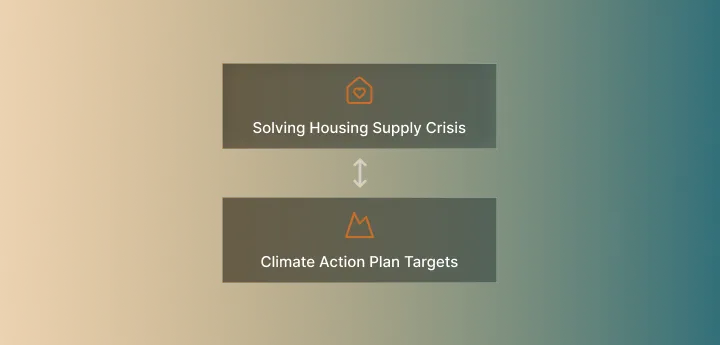
The Irish construction sector is undergoing a profound and necessary transformation, driven by twin national priorities: solving the housing supply crisis and meeting ambitious Climate Action Plan targets.
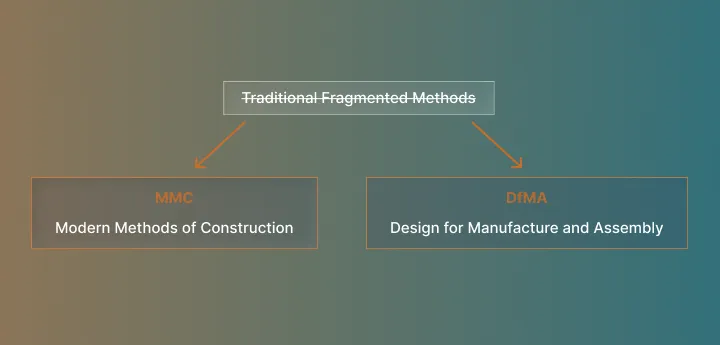
This transition mandates a fundamental shift away from traditional, fragmented methods towards a highly industrialised, technologically advanced, and carbon-conscious approach, centred around Modern Methods of Construction (MMC), Design for Manufacture and Assembly (DfMA), and stringent whole-life carbon assessments.
The Drive for Delivery: Industrialising Construction
The widespread adoption of MMC - which encompasses offsite manufacturing (OSM) and improved onsite techniques - is seen as a critical element in accelerating delivery and enhancing sustainability, productivity, and quality across the built environment.
MMC, often facilitated by DfMA processes, allows for significant advantages, including reduced construction time and long-term cost savings.
Industry sentiment, particularly among established players, suggests that client demand is increasingly shifting towards modular and volumetric solutions.
Ireland already hosts a dynamic MMC ecosystem, with over 100 offsite manufacturing companies operating in the country, 27 of which provide complete MMC housing solutions.

Experts believe the sector has the capacity to rapidly scale up annual housing output by 25,000 dwelling units if supported correctly.
Key actions to underpin this shift are actively progressing, including the Royal Institute of the Architects of Ireland (RIAI) developing a DfMA Overlay to the Plan of Work, aimed at increasing understanding and implementation among design teams.
The public sector is also expected to lead this change through exemplar projects, standardised design, and procuring construction services that facilitate MMC at scale, as detailed in the Housing for All strategy.
The Green Gauntlet: Decarbonising Concrete
While MMC addresses efficiency, regulatory shifts are forcing the industry to confront the embodied carbon of its materials head-on. Concrete, an essential material, poses a specific challenge, as the Irish cement sector was responsible for nearly 5% (4.8%) of Ireland’s total national emissions in 2022 (equating to 2.88 million tonnes of CO₂-equivalent).

To address this environmental burden, the Government of Ireland issued a major mandate for all state-funded construction projects (including roads, schools, and hospitals) from September 1, 2024.
These new rules legally prohibit the use of CEM I - the cement type associated with the highest emissions - in state agency-funded projects.
This mandate aims to compel the use of low-carbon cement. The Irish Concrete Federation (ICF) has already launched representative ready-mix Environmental Product Declarations (EPDs) to aid transparency in material choices.
Irish research is also paving the way for material innovation:
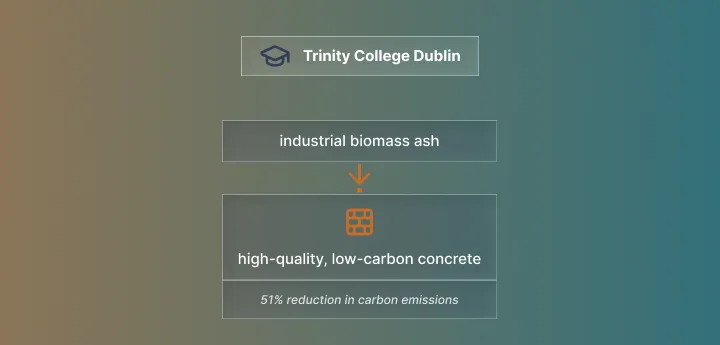
- Engineers at Trinity College Dublin School of Engineering have pioneered a way to transform industrial biomass ash - a common byproduct - into high-quality, low-carbon concrete.
- This method has been proven to achieve a 51% reduction in carbon emissions without compromising the concrete’s performance. This Enterprise Ireland-funded initiative is actively seeking to broaden its adoption across the country.
Measuring the Whole Lot: Whole-Life Carbon Methodology
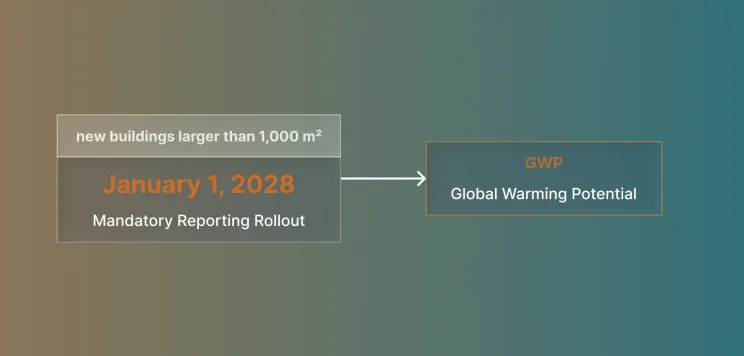
The calculation and reporting of Whole-Life Carbon (WLC) emissions, specifically the Global Warming Potential (GWP) of buildings, is becoming a mandatory requirement under EU legislation - specifically the recast Energy Performance of Buildings Directive (EPBD) (EU/2024/1275).
The Sustainable Energy Authority of Ireland (SEAI) is responsible for developing the national methodology for assessing WLC GWP for new buildings. This assessment covers all stages of a building’s life cycle (A to D), including the production of materials, transport, construction, operational energy use, maintenance, and end-of-life disposal, and must be compliant with the I.S. EN 15978:2011 standard.
Key implementation dates and requirements include:
- Mandatory Reporting Roll-out: Starting January 1, 2028, all new buildings larger than 1,000 m² must report their GWP, with this expanding to all new buildings by 2030.
- Public Sector Requirement: Exchequer-funded projects over a certain threshold must produce a WLC assessment starting June 1, 2026.
- Reporting Metrics: The final calculated GWP indicator must be expressed in kgCO₂eq (kilos of CO₂ equivalent) and reported on the Building Energy Rating (BER) certificate, showing the total impact per square metre of useful floor area.
- Data Standardisation: To support accurate calculations at the early design phase, SEAI is developing Ireland’s National Embodied Carbon Database of Building Materials. This database will provide generic data (Modules A1-A3) for materials consumed in Ireland, ensuring geographical representativeness. As projects mature, specific Environmental Product Declarations (EPDs) should be used.
Addressing the Deficiencies: Barriers to Scale
While the policy groundwork is laid, the industry stakeholders interviewed as part of the ongoing MMC research identify several critical gaps that must be addressed to successfully scale these modern approaches.
The Testing and Certification Hurdle
A persistent complaint across the sector is the lack of dedicated, domestic testing facilities. The industry urgently requires a national infrastructure of testing facilities for critical elements like fire safety, acoustic performance, thermal efficiency, and structural integrity of MMC/modular assemblies and their prototypes. Manufacturers currently rely on facilities in Belfast (Efectis) or the UK (Warrington), often forcing them to repeat expensive testing processes for certification (Agrément).
The National Standards Authority of Ireland (NSAI) Agrément certification process is crucial for new building materials and products for which national standards do not yet exist, especially for offsite and modular systems.
The Circular Economy Lag (DfR)
Despite the focus on sustainability and waste minimisation (a core component of the circular economy agenda), Design for Reuse (DfR) and Design for Deconstruction (DfD) remain largely neglected in current Irish policy and practice compared to the overwhelming focus on MMC and DfMA for upfront productivity.
Documents like the Housing for All roadmap and other key publications only mention ‘Reuse’ principles sparingly, often in the context of repurposing existing buildings rather than designing new ones for future reuse. Research suggests that successful DfR requires the development of standard connections designed specifically for disassembly (e.g., screw-fixed instead of welded/adhered). Overcoming negative public perception of reused materials is also a necessary task for knowledge transfer initiatives.
Skills, Digitalisation, and Standardisation
Stakeholders consistently emphasise the need for dedicated education, training, and Continuing Professional Development (CPD) programmes covering MMC, DfMA, and digital tools like BIM, noting a lack of modular training in traditional university/college curricula.
To achieve the scalability required for MMC, there is strong industry demand for certified universal housing systems employing standardised typologies that allow for cost-efficient production and repetition, while still permitting reasonable design variation.
This approach would simplify procurement, mitigate risk, and provide the volumetric pipelines needed for manufacturers to make the shift commercially viable.
Sources
- https://cif.ie/wp-content/uploads/2022/01/1271-CIF-Modern-Methods-of-Construction-Report-v4.pdf
- https://mmcireland.ie/nesc-report-insights-and-industry-responses-on-the-future-of-mmc-in-ireland/
- https://constructinnovate.ie/wp-content/uploads/2024/08/2024-CI-Design-for-Manufacture-and-Assembly-with-Design-for-Reuse.pdf
- https://www.tcd.ie/e3/news/from-ashes-to-concrete-a-new-era-dawns-in-sustainable-construction/
- https://oneclicklca.com/en/resources/articles/ireland-cement-mandate-for-state-building-projects
- https://irishconcrete.ie/icf-publishes-ready-mixed-concrete-environmental-products-declarations/
- https://www.seai.ie/sites/default/files/2025-04/life-cycle-gwp-calculation-methodology.pdf
- https://www.gov.ie/en/department-of-enterprise-tourism-and-employment/publications/procurement-guidance-for-public-bodies-reducing-embodied-carbon-in-construction/


