

Ireland’s construction sector in 2025 faces a perfect storm of challenges that would overwhelm traditional approaches. With housing delivery falling catastrophically short of targets, projected to deliver only 25,000 homes instead of the government’s ambitious 41,000 target, the industry confronts its most difficult period in recent memory.
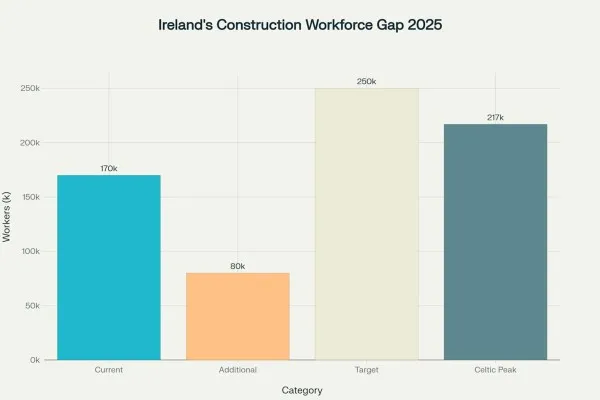
The industry requires an additional 80,000 workers - a 47% increase from current levels - to meet infrastructure demands over the next decade. This workforce gap, combined with rising costs, complex new regulations, and persistent supply chain disruptions, creates what industry experts describe as an “unprecedented convergence of challenges”.
The Labor Crunch: A Catalyst for Revolutionary Change
Ireland’s acute labor shortage has reached crisis proportions, with 63% of construction companies struggling to find skilled workers. Construction now accounts for 28% of all difficult-to-fill vacancies in the country, creating severe bottlenecks in project delivery. The situation reflects broader demographic shifts, as more young people pursue university degrees or technology careers rather than traditional construction trades.
This workforce crisis is compounded by an aging construction workforce, with many experienced professionals retiring while insufficient young workers enter the field. The government estimates that to achieve even half of Ireland’s housing targets over the next five years would require an unprecedented increase to 60,000 homes annually - nearly double current delivery rates.

However, this challenge has become a powerful catalyst for innovation across the industry. Companies that embrace digital transformation and modern construction methods are discovering they can achieve more with fewer hands on deck, while simultaneously improving quality, safety, and efficiency.
PETRUF’s Creative Response: Innovation at Every Stage
PETRUF’s approach to Ireland’s construction challenges exemplifies how consulting engineers can lead industry transformation through strategic innovation across multiple dimensions.
1. Offsite and Precast Solutions: Factory Precision Meets Site Efficiency
PETRUF’s focus on precast concrete and modular construction methods represents a fundamental shift in how projects are delivered. By moving labor-intensive activities from chaotic construction sites to controlled factory environments, these approaches directly address the acute on-site workforce shortage while delivering superior quality outcomes.

Modern precast concrete facilities showcase the potential of this transformation. Factory production allows for precise quality control, weather-independent manufacturing, and the ability to produce high-quality components with a smaller, more specialized workforce. Studies demonstrate that modular construction can reduce project timelines by 30-50% while cutting construction costs by 7-20%.
The Irish market is experiencing significant growth in modern methods of construction, with precast concrete projected to expand from 15% current market share to 20% by 2030, while modular construction is expected to double from 5% to 10% over the same period.

2. Digital Engineering and BIM: Data-Driven Decision Making
PETRUF’s implementation of Building Information Modeling (BIM) and digital engineering tools represents another crucial innovation pillar. BIM technology enables the creation of detailed 3D models that represent both physical and functional characteristics of buildings and infrastructure, facilitating unprecedented collaboration and precision.
The power of BIM extends far beyond traditional design visualization. Modern BIM platforms integrate with AI-driven project management systems, enabling predictive scheduling, risk assessment, and resource optimization that directly address the challenges posed by workforce constraints. Digital twins technology allows for real-time monitoring of construction progress, equipment performance, and safety compliance.
Irish firms adopting BIM report significant efficiency gains, with some studies showing engineering hours reduced by up to 30% through improved coordination and reduced rework. The technology also supports remote collaboration, enabling engineers to contribute effectively to projects regardless of physical location - a crucial capability in today’s constrained labor market.
3. Design for Constructability: Optimizing Every Element
PETRUF’s emphasis on constructability review and value engineering ensures that designs are optimized for efficient execution with available resources. This approach involves scrutinizing design documents, construction methods, and materials to identify potential issues that could impede project progress.
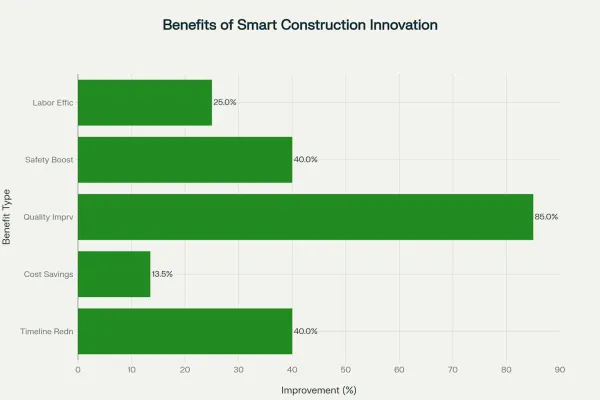
Early contractor involvement in the design process has proven particularly valuable, with studies showing cost savings of 7% and time savings of 10% during the construction phase.
Partnerships and Early Collaboration: Strength Through Unity
Early engagement proves particularly valuable in today’s constrained environment, where careful coordination can prevent costly delays and resource conflicts. By participating in design development from the earliest stages, PETRUF helps optimize projects for efficient delivery while maintaining quality standards and regulatory compliance.
The integration of smart construction technologies - including drones for site surveying, IoT sensors for equipment monitoring, and AI-powered safety systems - further enhances collaborative capabilities. These tools provide real-time data that enables all project stakeholders to make informed decisions quickly, reducing the impact of traditional communication barriers and coordination challenges.
Ireland’s construction sector projects continued growth - 3.3% in 2025 followed by annual average growth of 4.8% from 2026 to 2029 - supported by public and private investments in transport, electricity, and residential infrastructure. This growth occurs against the backdrop of persistent challenges, making innovative approaches essential for successful project delivery.


